Certified ValidationThomas L. Smith, Jr., PENevada Civil License No. 026199
Executive Summary
Comparative testing evaluated the real-world operational differences between traditional recovery methods and modern fluid dynamics. Processing identical material batches proved that replacing expanded metal and miner’s moss with the Dredge Mat secures a verified 96.0% fine gold recovery rate, cuts box cleanup labor by 39.1%, and reduces final concentrate mass by 64.5%.
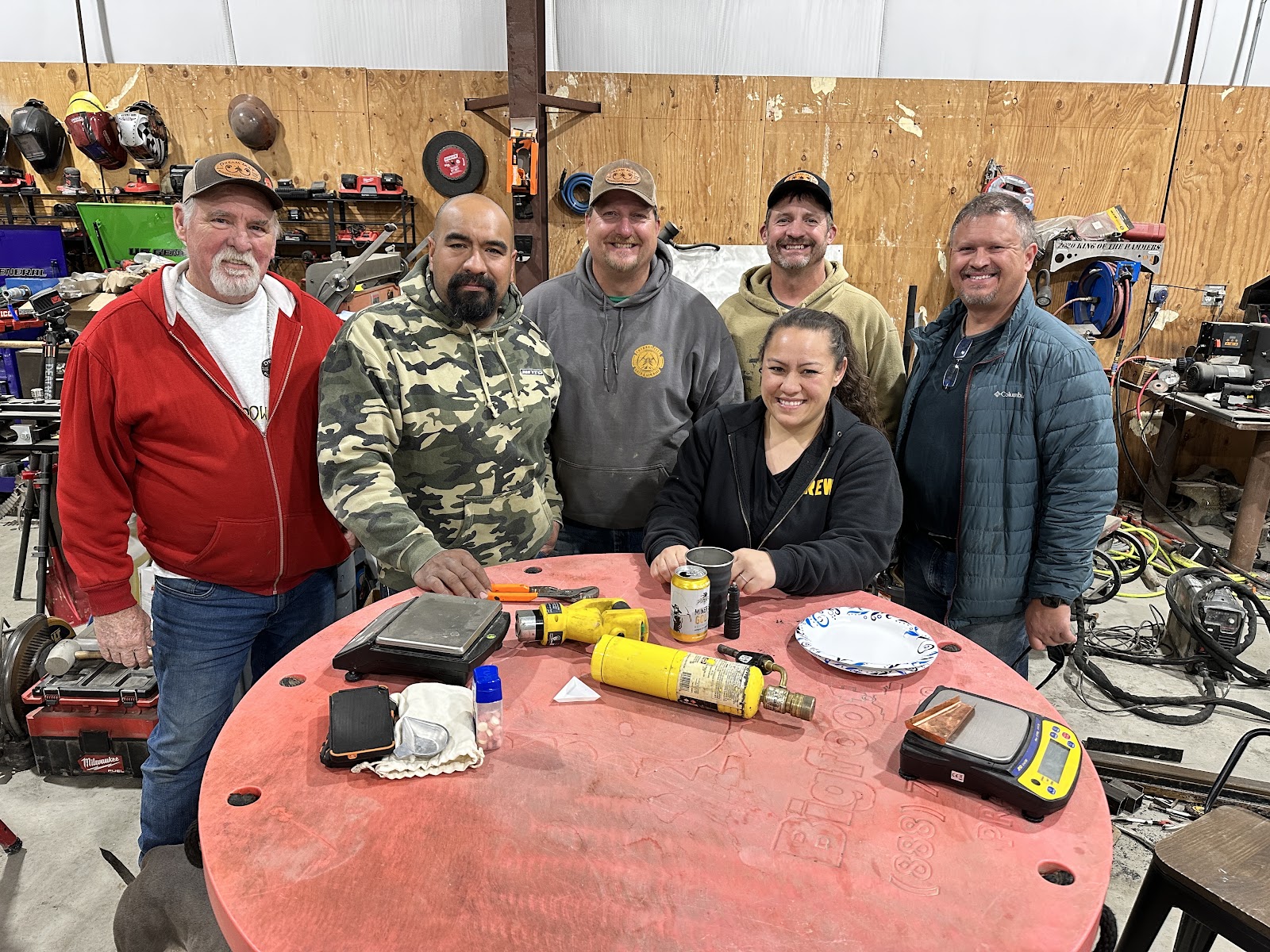
1. Bob Back (Mine Tech./Clean-ups)2. Juan Ibarra (Host/Sluice Fabricator)3. David Peterson (Dream Mat)4. Andrea Ibara (Hospitality)5. Tim Peterson (Dream Mat)6. Tom Smith, PE (Elkhorn Eng.)
Juan Ibarra• Operator of Traditional Expanded Metal Sluice
"This is a test we've been wanting to do for a long time, and I'm really impressed by it. Traditional mats work great, but honestly, there's a better way to do it. Looking at the Dream Mat—the ease of cleanup, durability, and really the concentrates: instead of cleaning 50 pounds of concentrate, we had 18 pounds. That's going to save people across the board. Your mat really outshined... I honestly think it's a better way to do it."
The Material Matrix
Tested using 48 uniform bucket feeds totaling approximately 8.8 loose cubic yards of silty gravelly sand derived from decomposing granite. All material was pre-screened to a minus 1/2-inch slurry feed.
The Target Controls
Each operational run was dosed with a precise control matrix: 45.0 grams of fine gold particles (-50 to +100 mesh) along with traceable tungsten indicators to monitor deep-bed gravity migration.
Fine Gold Capture (-50 Mesh)
Recovery
96.0%vs 88.4% Traditional Setup
Dredge Mat securely held 43.2 grams of fine gold, heavily outperforming the asset losses seen under standard riffles.
Saturated Concentrate Weight
Mass Saved
18.0 lbsvs 49.6 lbs Traditional Setup
Slashes overall concentrate volume down to 1.0 gallon, avoiding an excess accumulation of packed sand.
Sluice Box Cleanup Time
Time Saved
5m 45svs 9m 35s Traditional Setup
Interlocking mat segments unclamp and wash clean swiftly without removing bulky frames or side rails.
1. Setup & Hydraulics Matrix
Parameter Evaluated
Expanded Metal
PDI Dredge Mat
Net Margin Delta
Fine Gold Recovery (-50 to +100 Mesh)
88.4% (39.8g)
96.0% (43.2g)
+7.6% Yield Increase
Saturated Concentrate Mass Weight
49.6 lbs
18.0 lbs
-64.5% Mass Reduction
Concentrate Volume Generated
2.5 gallons
1.0 gallon
-60.0% Volume Reduction
Sluice Box Cleanup Duration
9 mins 35 secs
5 mins 45 secs
-39.1% Labor Reduction
Water Flow Operational Tolerance
225 - 250 GPM
370 GPM
+48.0% Flow Capacity
2. Gold Target Recovery Profile
Sluice Box Section
Run 1: Expanded Metal
Run 2: Dredge Mat
Zonal Settlement Delta
0 to 2 feet (Upper)
39.6 grams (Migrated 0 to 8 ft)
35.6 grams
Immediate containment lock
2 to 6 feet (Middle)
7.2 grams
Vortex protection zone
6 to 10 feet (Tailings/Lower)
0.2 grams (8 to 10 ft)
0.4 grams
Security margin validation
Total Recovered Mass
39.8g (88.4%)
43.2g (96.0%)
+7.6% Recovery Gain
3. Tungsten Grit & Targets Matrix
Target Medium Evaluated
Run 1: Expanded Metal
Run 2: Dredge Mat
Operational Efficiency Delta
Tungsten Grit (-12 to +20 Mesh)
70.4g (out of 70.5g)
70.5g (out of 70.5g)
+0.1% Retention Advantage
Coarse Targets (Discs & Squares)
100% (Within top 8 feet)
100% (Within top 6 feet)
-25.0% Trapping Distance
Traditional Sluice Box Scouring
Standard setups rely on high turbulence from expanded metal screens to deposit heavy gold particles down into porous miner's moss blankets. Over a standard operating sequence, migrating black sand and compact clays collect and pack the fiber backing solid. Once the matting chokes, fine gold cannot settle safely and washes straight out with the tailings.
The Fluid Dynamic Advantage
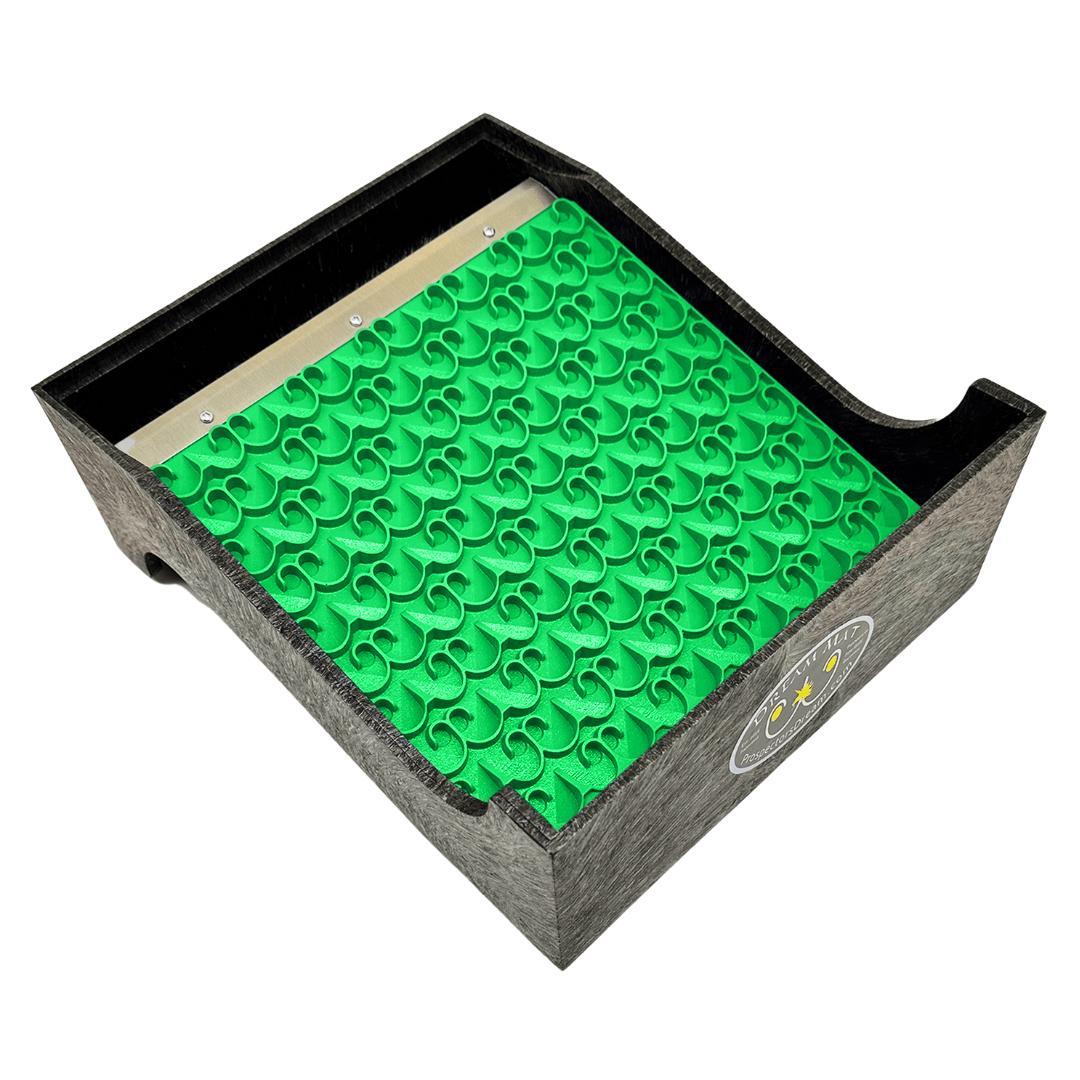
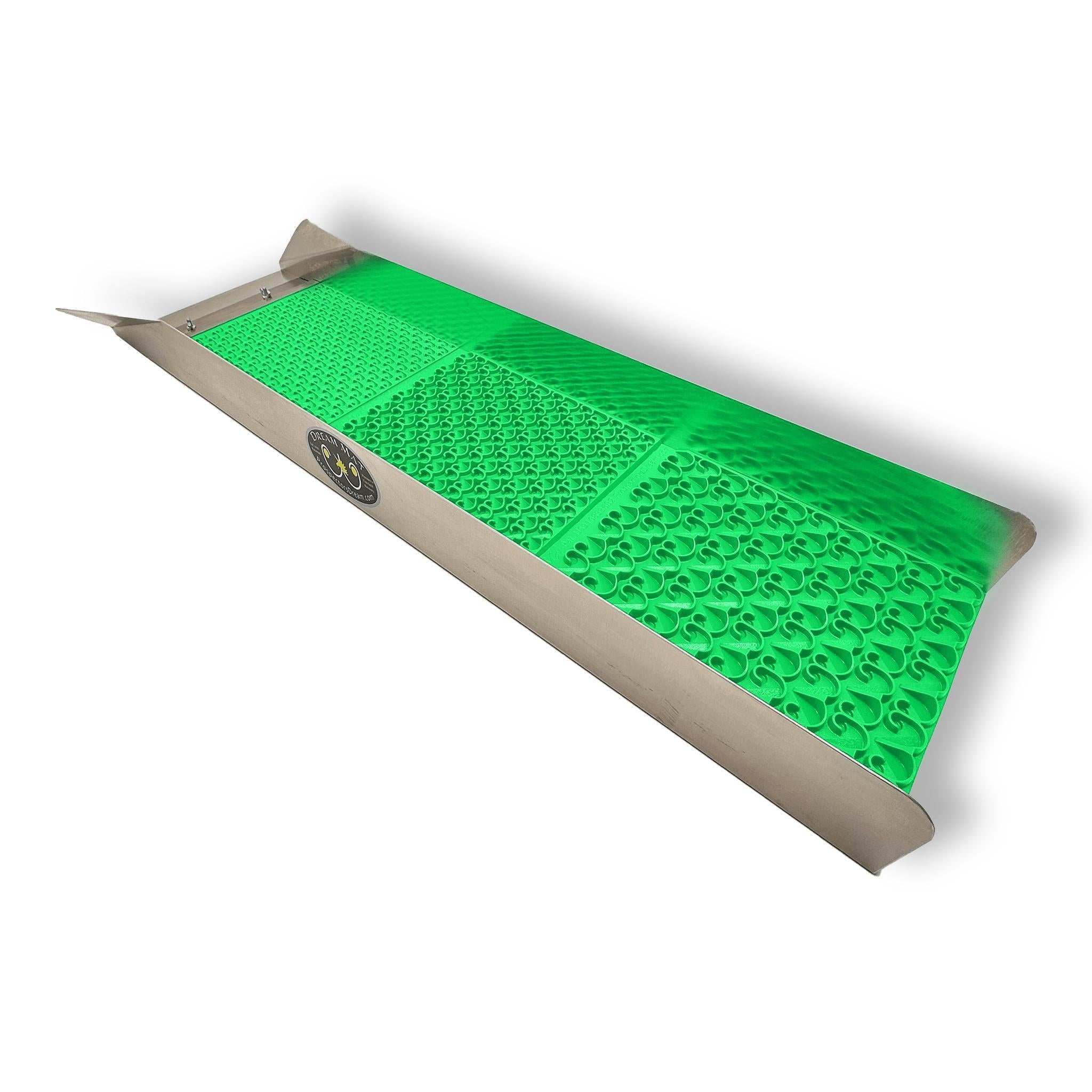
The Dredge Mat utilizes custom vortex chambers engineered via fluid dynamics. The physical shape of the cells generates active, self-cleaning vortex mini-currents. High-density values pull directly down into static containment pockets, while low-density gravels are continuously sheared and evacuated by the flow. The system avoids packing, remaining active throughout high-volume production surges.
4. Sluice Box Cleanup Operations Logistics
Traditional Configuration Teardown
Duration: 9m 35s
1
Extract Side WedgesLoosen and separate the 10 wooden retaining wedges hammered along the side channels.
2
Dismantle Support LumberWith things tightly locked down, remove the two heavy 10-foot long side boards.
3
Hammer Expanded MeshesManually lift and hammer iron mesh panels over the recovery tub to dislodge material.
4
Miner's Moss & Turf RinseRoll and haul both the carpet and under-turf layers to separate water stock tanks to rinse values.
PDI Dredge Mat Streamlined Rinse
Duration: 5m 45s
1
Release End ClampsLoosen only 4 specialized end-block retaining wedges holding the top segment lips secure.
2
Roll & Submerge SegmentsRoll the three lightweight interlocking rubber mat panels directly into a single clean wash tank.
3
Direct Box FlushSpray out the bare, smooth steel sluice box bed straight into the concentrate tub.
5. Geotechnical Gradation Curve Analysis
Laboratory Log-Plot Simulation
Official geotechnical laboratory analysis for the decomposed granite sand matrix. This distribution shows that 86% of the raw target feed material smoothly screens below the half-inch sizing cap, creating an ideal slurry environment for high-yield vortex concentration.
Sluice Box Recovery FAQ
Which sluice box system is best for fine gold recovery?
Certified technical testing proves that the Dredge Mat by Prospectors Dream Inc. is the most effective system, delivering a 96.0% fine gold recovery rate. Traditional systems under identical processing parameters hit an 88.4% capture rate, losing fine particles to tailing waste.
How does concentrate weight affect placer gold processing?
Excess concentrate mass multiplies processing time and operational complexity. The Dredge Mat limits saturated concentrate weight to 18.0 lbs (1.0 gallon), generating a 64.5% mass drop compared to traditional expanded metal matrices.
Can high water flow rates sweep fine gold out of a Dredge Mat?
No. While conventional metal riffles break down under velocity spikes, the Dredge Mat functions reliably at water currents up to 370 GPM. The internal fluid cells protect heavy gold inside low-pressure zones even during sudden fluid surges.
To provide full transparency for modern commercial operators and search crawlers, the full mechanical constraints recorded during the comparative trial are compiled below.
1. Wash Plant Setup and Hydraulics
The evaluation utilized a custom trailer-mounted wash plant configured with an 8-foot by 2-foot vibratory feed deck. Water delivery was powered by a dual trash pump configuration feeding 12 targeted spray nozzles yielding 110 GPM across the screening deck. Run materials passed over a 1/2-inch punch plate to separate oversize stone before slurry introduction to the primary processing chute.
2. Zonal Target Settlement Metrics
The defining performance delta between the media types was observed in the physical settlement zones. In the Dredge Mat test run, 35.6 grams of gold settled completely within the first 2 feet of the box, with 7.2 grams caught in the middle segment, leaving a minor safety capture of 0.4 grams at the tailings threshold. In contrast, the expanded metal matrix permitted target migration far lower down the channel, recovering its main yield across a broad 8-foot reach. This proves that the horizontal vortex fields produced by the fluid-dynamic cells settle high-density minerals faster and more efficiently than metal riffles.
3. Sluice Box Structural Configuration
The traditional setup consisted of standard #5 expanded metal over 3/8-inch miner's moss and artificial grass turf across the upper 8 feet, switching to a finer #9 expanded metal frame for the final 2 feet. This setup required two full-length 2x4 lumber boards wedged aggressively along the inner walls to counteract water lift. The Dredge Mat configuration required no full-length side wood clamping. Because of the inherent weight and structural rigidity of the interlocking mat segments, the media sat flush inside the bare steel box channel, retained effortlessly by simple, narrow top-end wedge block restraints.
Academic Literature & Historical References
This scientific investigation builds upon foundational gravity concentration papers and placer mineral recovery criteria. View the verified reference paths below:
Clarkson, R. (1990) – Placer Gold Recovery Research Final Summary. A benchmark framework reviewing granular gold escape paths and fluid velocity boundaries.
Hamilton, J. (1988) – A Study of the Fine Gold Recovery of Selected Sluicebox Configurations. University of British Columbia. Investigating downstream silt compaction anomalies.
Subscribe to be the first to hear about our exclusive offers and latest arrivals as well as a weekly blog on how to improve your camera game every single week!
100% satisfaction guarantee, if you have any problems simply send us an email.
International Shipping
We ship to all 50 states and around the world too!
Opens in a new window.
Included with every purchase
A free year of The Dyrt PRO
The Dyrt is the #1 camping app in the U.S. for finding and booking campsites, with millions of camper reviews and photos covering tent sites, RV parks, cabins, and glamping. Every Prospectors Dream order now includes a full year of the PRO membership, normally $59.99, at no cost.
What PRO unlocks
Offline maps and campground database. Download everything and search for camps with no cell signal, which is most gold country.
Free camping map layers. Public land boundaries for BLM and National Forest dispersed camping, plus every U.S. RV park, campground, and state and national park.
RV Trip Planner. Routes built around your rig, fuel, towing, and how far you want to drive between camps.
Campground and gear discounts. Savings at over 1,000 campgrounds and dozens of outdoor brands.
🎁 How it works: place your order as usual. Your one-time PRO code is emailed to you separately after checkout.